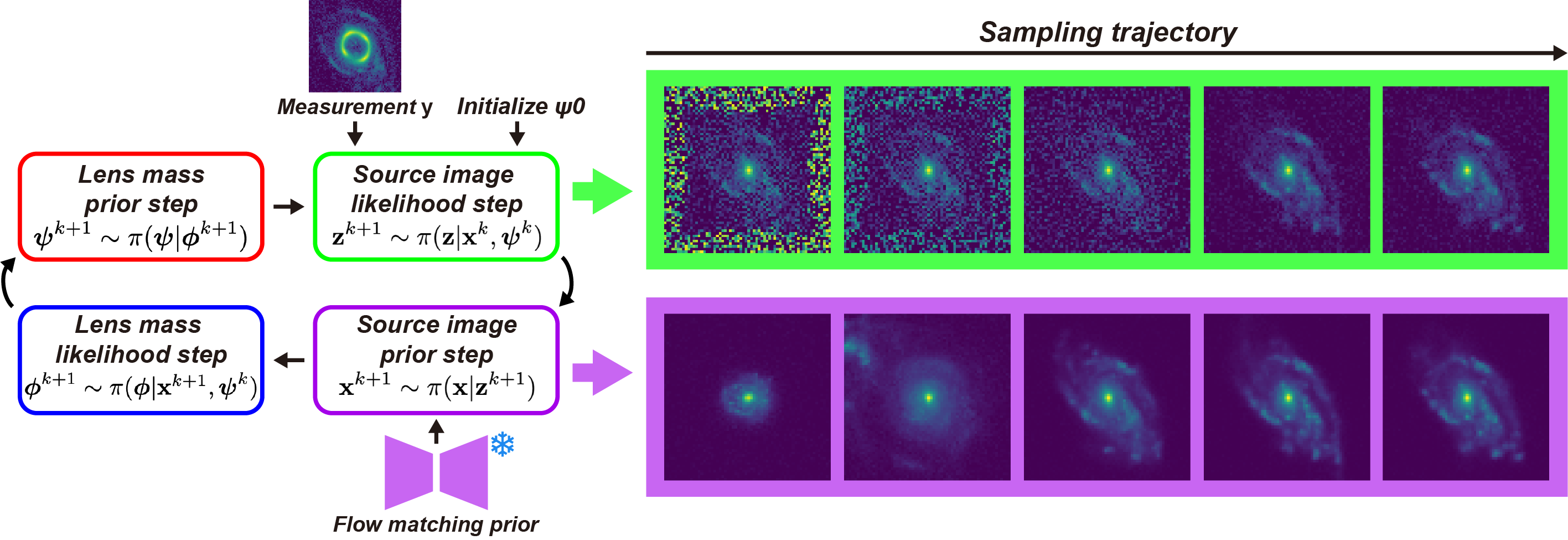
Strong gravitational lensing reveals important information about the universe, but reconstructing the source image and lens properties requires solving an ill-posed inverse imaging problem. Generative image models serve as powerful data-driven priors in Bayesian inverse problems. Diffusion models have been used widely, but they are computationally costly. Flow matching has emerged as a promising alternative to diffusion models, with the advantage of straighter probability paths that enable easier training, efficient sampling, and better-quality data generation. In this work, we present Blind-FlowSGS, a principled blind posterior sampling method using flow matching priors, enabling efficient posterior sampling for non-blind and blind inversion of strong gravitational lenses. On simulated Euclid data, we demonstrate our method's improvement over diffusion-based methods in both efficacy and efficiency. Our method shows promising capabilities to accurately process strong lensing data from modern sky surveys at scale.
@article{li2026probabilistic,
    author    = {Li, Tianao and Gonz\'alez, Jimena and Xu, Xinfeng and Katsaggelos, Aggelos K. and Willett, Rebecca and \'Ciprijanovi\'c, Aleksandra and Starkenburg, Tjitske and Alexander, Emma},
    title     = {Probabilistic Inversion of Strong Gravitational Lenses with Flow Matching Priors},
    booktitle = {The 9th Workshop on Machine Learning and the Physical Sciences (ML4PS)},
    year      = {2026}
}We gratefully acknowledge the support of the NSF-Simons AI Institute for the Sky (SkAI) via grants NSF AST-2421845 and Simons Foundation MPS-AI-00010513. This material is based upon work supported by the U.S. National Science Foundation under Award No. 2542022. This research used the Delta advanced computing and data resource, which is supported by the National Science Foundation (award OAC 2005572) and the State of Illinois. Delta is a joint effort of the University of Illinois Urbana-Champaign and its National Center for Supercomputing Applications. This work was produced by Fermi Forward Discovery Group, LLC under Contract No. 89243024CSC000002 with the U.S. Department of Energy, Office of Science, Office of High Energy Physics. The authors would like to thank Yu Sun for helpful discussions.