FlowSGS: Improving Flow Priors for Inverse Imaging with Stochastic Interpolants

arXiv preprint, 2026

1Northwestern University, 2NSF-Simons AI Institute for the Sky (SkAI)
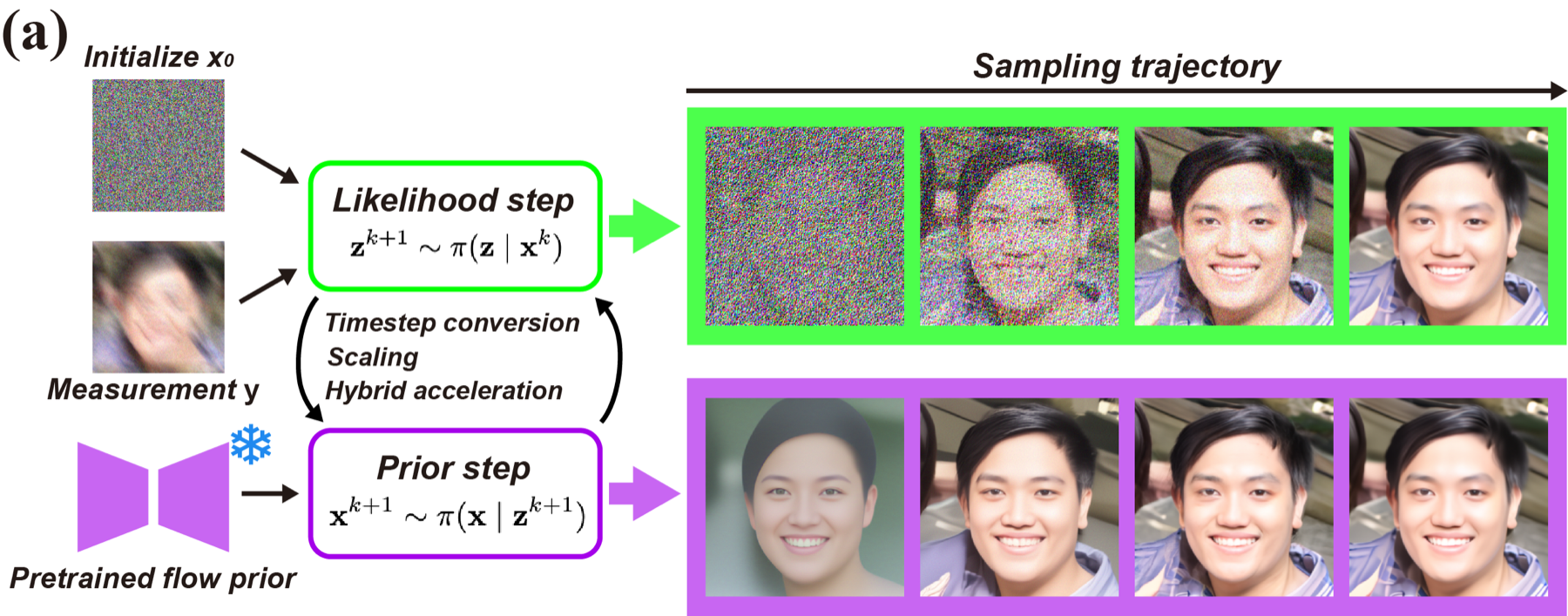
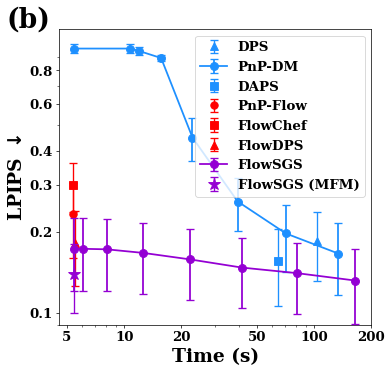
Overview of the FlowSGS sampler and its sampling trajectories LPIPS versus sampling time for motion deblurring
A high-level overview of FlowSGS, a principled posterior sampler using flow matching as a plug-and-play prior. (a) Our method iterates between a likelihood step and a prior step, where the former uses proximal sampling or Langevin dynamics as appropriate to the problem, and the latter involves solving a reverse-time SDE using a pretrained flow prior. (b) Our method achieves high efficiency with flow priors, here averaged across 100 samples of motion deblurring.

Abstract

Flow matching has emerged as the state-of-the-art generative model and has been used for plug-and-play (PnP) priors to solve inverse problems in computational imaging. However, existing flow-based inverse solvers make simplifying approximations in posterior sampling and/or assume linear forward models. In contrast, principled diffusion-based methods exist but are computationally expensive. To circumvent these problems, we introduce FlowSGS, a flow-based posterior sampling method using Split Gibbs Sampling (SGS) with annealed coupling, and make flow-specific interventions to the prior sampling and annealing steps, theoretically grounded in the Stochastic Interpolants (SI) framework. Using a novel timestep correction and accelerated warm-up with one-step flow models, our method is faster and more accurate than the state of the art across a range of imaging problems. We demonstrate the first use of flow-based samplers for a nonlinear inverse problem (Fourier phase retrieval) and apply one-step flow models to principled Bayesian inverse imaging.

Toy Problem

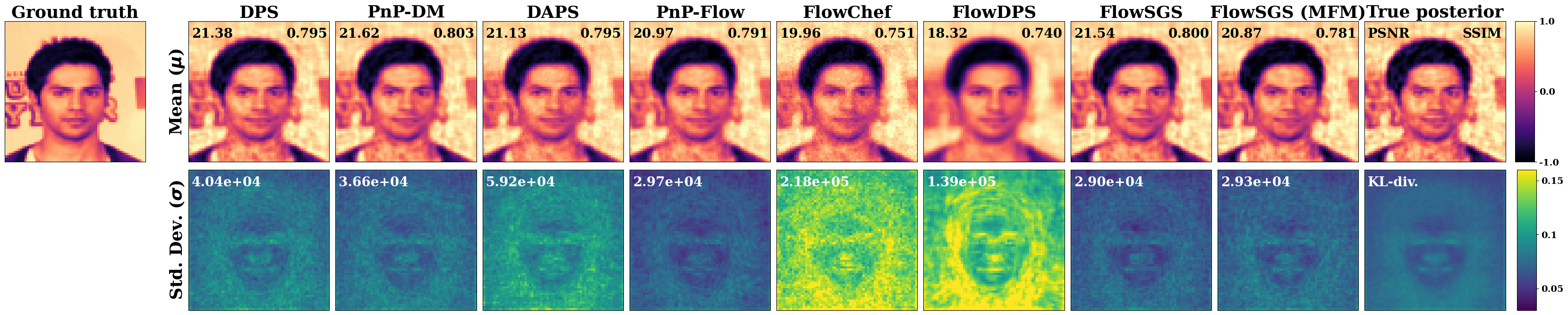
Posterior means and standard deviations on a toy compressed-sensing problem
Results on a toy compressed-sensing problem with an analytically available Gaussian posterior. We show the mean image (row 1) and pixel-wise standard deviations (row 2) for the Gaussian posteriors. Our method estimates an accurate posterior with the lowest KL divergence compared to the true posterior.

Linear Inverse Problems

Motion deblurring results Super-resolution results Cartesian MRI reconstruction results
Visual results on linear inverse problems. We draw 8 posterior samples for each method and report the mean image. More results are shown in the paper.

Nonlinear Fourier Phase Retrieval

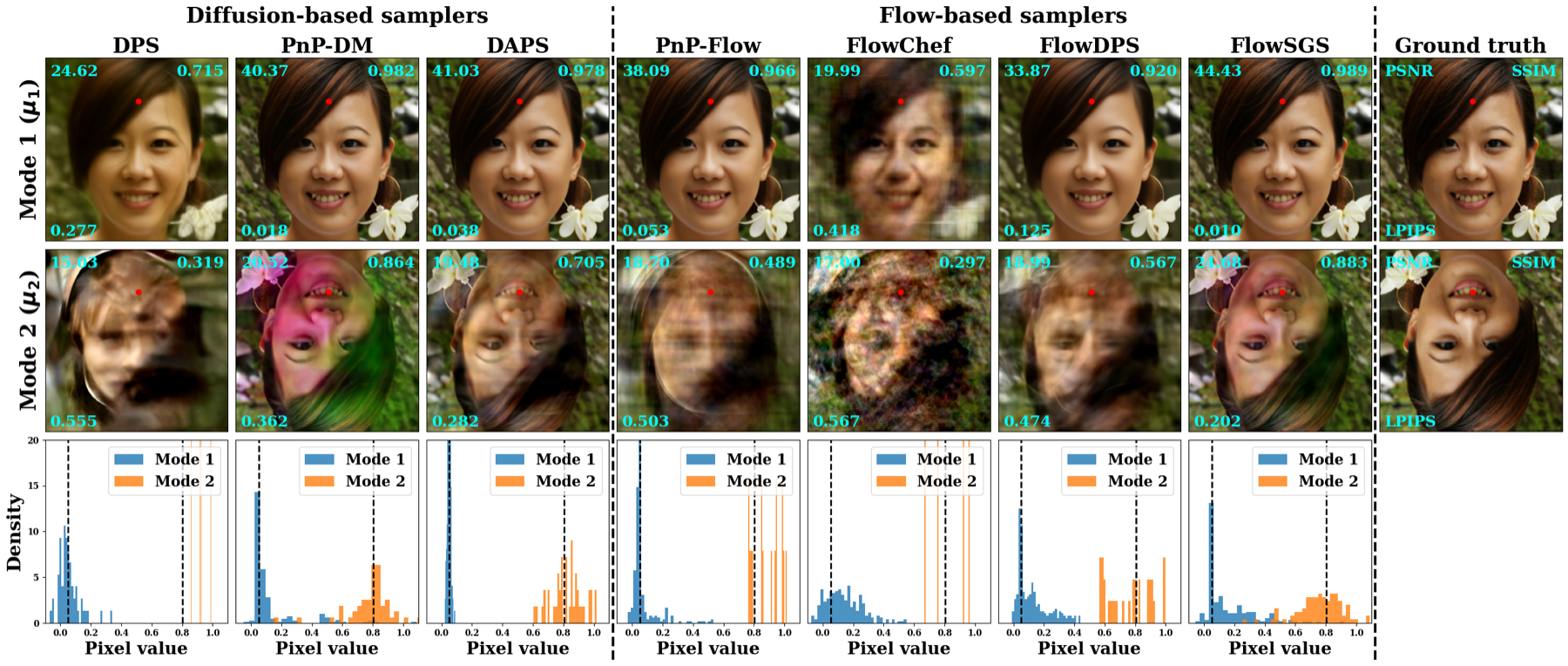
Bimodal posterior samples and pixel histograms for Fourier phase retrieval
Bimodal posterior for nonlinear Fourier phase retrieval. With each method, we draw 512 samples and classify them into two modes. We compute the mean image using the top 25% images for each mode, and show the histograms for a pixel in the red channel (marked by red dots).

Ablation Studies

Illustration of the timestep correction Motion deblurring results when ablating each intervention LPIPS versus number of discretization steps
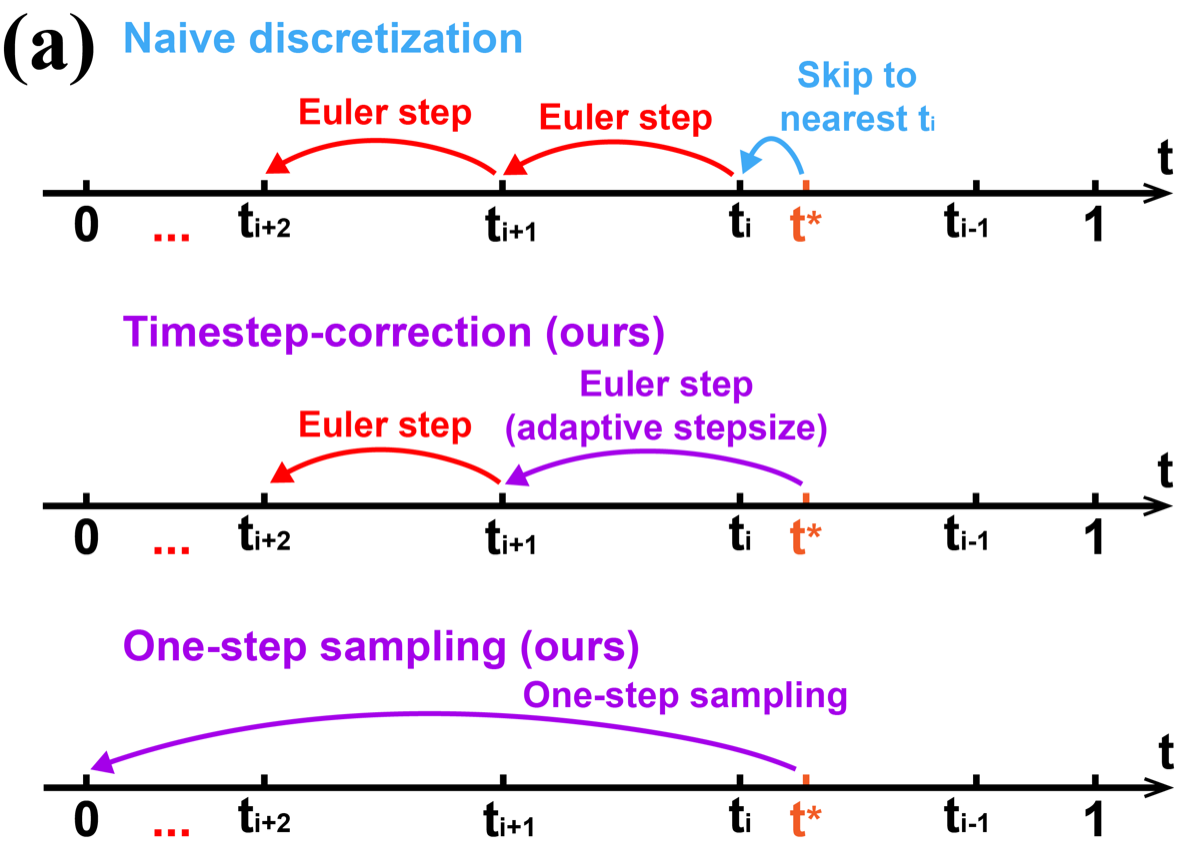
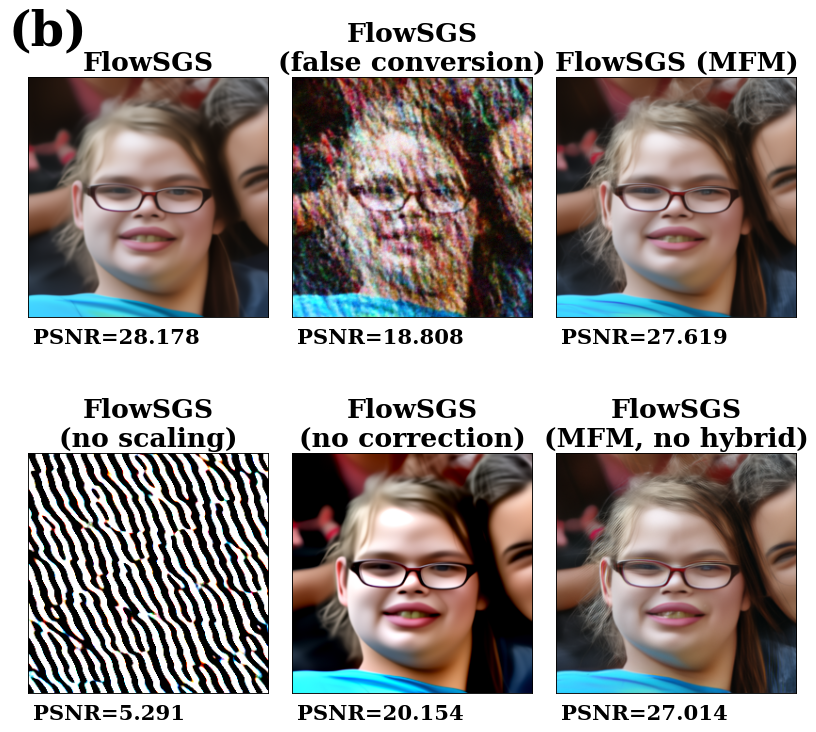
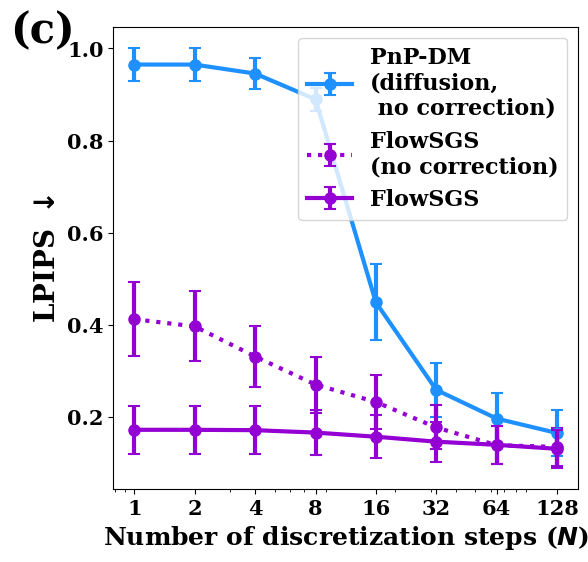
Timestep-correction and one-step flow models enable efficient sampling. (a) Illustration of FlowSGS's robust timestep correction to reduce discretization error. (b) Ablating our interventions decreases image quality on motion deblurring. See ground truth in the linear inverse problem results above. (c) Removing the timestep correction (dashed purple) limits reconstruction performance for lower discretization step counts N. For small N, the timestep correction improvement (dashed purple to purple) is on the same order as the diffusion-to-flow improvement (blue to dashed purple). All experiments here are done with motion deblurring, averaged over 100 test samples (error bars show standard deviations).

Citation

@article{li2026flowsgs,
    author  = {Li, Tianao and Qian, Xinhui and Alexander, Emma},
    title   = {FlowSGS: Improving Flow Priors for Inverse Imaging with Stochastic Interpolants},
    journal = {arXiv preprint arXiv:2609.20769},
    year    = {2026}
}

Acknowledgements

We gratefully acknowledge the support of the NSF-Simons AI Institute for the Sky (SkAI) via grants NSF AST-2421845 and Simons Foundation MPS-AI-00010513. This material is based upon work supported by the U.S. National Science Foundation under Award No. 2542022. This research used the Delta advanced computing and data resource, which is supported by the National Science Foundation (award OAC 2005572) and the State of Illinois. Delta is a joint effort of the University of Illinois Urbana-Champaign and its National Center for Supercomputing Applications. The authors would like to thank Yu Sun, Deliang Wei, Rebecca Willett, and Tjitske Starkenburg for helpful discussions, and three anonymous reviewers for insightful feedback.